
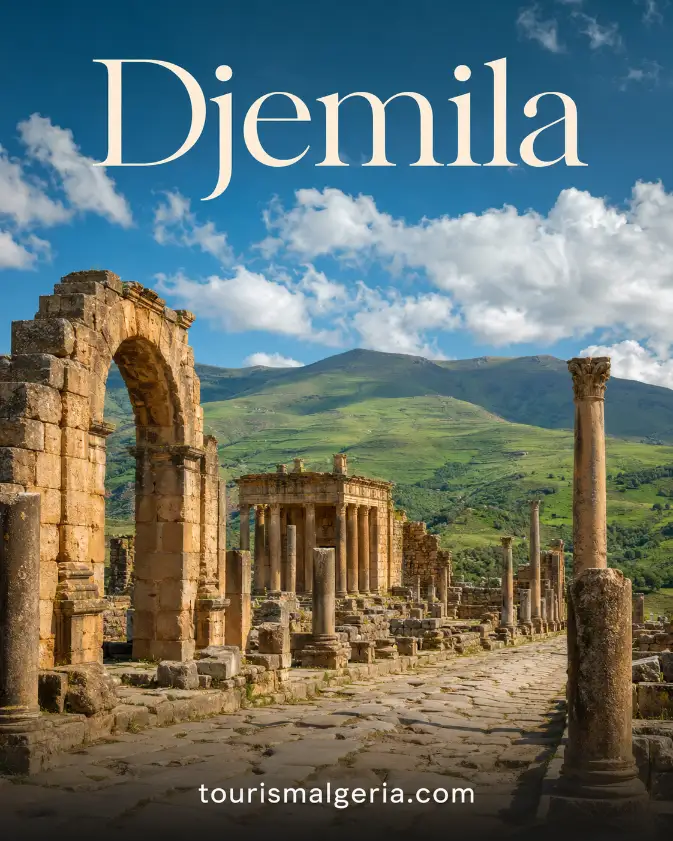
Why Djemila Is Important
Djemila is important because it shows how Roman architecture and town planning were adapted to a difficult mountain location, creating a city with forums, temples, basilicas, triumphal arches, houses and public spaces shaped by the terrain.
Where the Ruins Are Located
The archaeological site of Djemila is located about 50 kilometres north-east of Sétif, making it a major heritage excursion for travellers visiting Sétif, Constantine, eastern Algeria or the Roman archaeological routes of the country.
Djemila and Its Ancient Name Cuicul
Before becoming known as Djemila, the city was called Cuicul, an ancient Roman colony established in a highland setting where civic buildings, religious monuments, markets and residential quarters gradually developed around the needs of Roman urban life.
Roman Architecture in a Mountain Landscape
Unlike a flat Roman city such as Timgad, Djemila is especially interesting because its streets and buildings follow the constraints of hills, slopes and rocky ground, giving the site a dramatic visual character surrounded by green highland scenery.
The UNESCO Value of Djemila
UNESCO recognises Djemila for its outstanding Roman remains and for the way the ancient city illustrates Roman town planning adapted to a mountain environment, making it one of Algeria’s most important archaeological destinations.
What Visitors Can See in Djemila
Visitors can see stone streets, columns, temples, basilicas, houses, arches, markets, baths, a theatre and museum collections, with many remains still arranged in a way that helps travellers understand the structure of the ancient city.
The Theatre of Djemila
The Roman theatre is one of the major monuments of Djemila, showing the role of public entertainment, civic gathering and cultural life in ancient Cuicul, while also offering a strong visual impression of the site’s preserved architecture.
Forums, Temples and Public Squares
Djemila contains important civic and religious spaces, including forum areas, temples and monumental structures that reveal how political, commercial, religious and social life was organised in a Roman city built far from the Mediterranean coast.
The Arch of Caracalla
The Arch of Caracalla is one of the most recognisable monuments at Djemila, adding a triumphal and imperial dimension to the site and giving visitors a strong photographic landmark within the wider Roman urban landscape.
Djemila Museum and Mosaics
The Djemila museum is important because the site is known for remarkable mosaics and archaeological objects, helping visitors understand the artistic, domestic and religious life of the ancient city beyond the stone ruins themselves.
Best Time to Visit Djemila
The best time to visit Djemila is usually spring or autumn, when the mountain climate is more comfortable for walking, photography and exploring open-air ruins without the strongest summer heat or difficult weather conditions.
How Long to Spend at the Site
A proper visit can take several hours, especially if travellers want to explore the theatre, forum areas, temple remains, arches, streets, museum and viewpoints rather than making only a quick stop during a regional journey.
Practical Travel Base for Djemila
Sétif is the most practical base for visiting Djemila, while Constantine can also be included in a wider itinerary combining Roman ruins, bridges, museums, city heritage and eastern Algerian landscapes.
Main Highlights of the Djemila Ruins
- Roman Theatre
The theatre is one of the most impressive structures at Djemila and helps visitors imagine public performances, gatherings and entertainment in ancient Cuicul. - Arch of Caracalla
This monumental arch is a key landmark of the site and one of the most photographed Roman remains in Djemila. - Forum Areas
The forum spaces show the civic heart of the ancient city, where public, political and commercial activity would have taken place. - Temples and Religious Buildings
The temples and later religious structures reveal the changing spiritual history of the city across Roman and Christian periods. - Basilicas
The basilicas of Djemila show the architectural and religious development of the site as the city evolved over several centuries. - Roman Streets
The stone streets help visitors follow the ancient urban plan and understand how movement was organised across the mountain settlement. - Residential Quarters
The remains of houses and domestic spaces show how inhabitants lived inside a Roman city adapted to local geography. - Public Baths
The bath remains illustrate the importance of hygiene, leisure and social life in Roman urban culture. - Mosaics and Museum Collections
The mosaics are among the major cultural attractions of Djemila and help complete the visitor experience beyond the outdoor ruins. - Mountain Setting
The surrounding hills make Djemila especially memorable, because the ruins are not only historic but also visually dramatic in their natural landscape.
Djemila Ruins Step by Step: Reading the Site on Foot
The best way to understand the Djemila ruins is to treat the walk as a sequence of levels rather than a flat tour. Because the ancient town climbs and drops with the hillside, each turn changes the view, and the stone remains make most sense when you notice how the builders used ridges for important buildings and lower ground for everyday life.
Start by looking at the ground itself. Worn paving, kerb lines, drains and doorway thresholds tell you more about daily routines than the tallest column does. Slow walking is rewarded here, and a short pause at each junction helps you notice how streets narrow, bend and open into squares.
Djemila Ruins and the Surrounding Highland Scenery
Djemila stands in open highland country, and the setting is part of the visit. Fields, hills and wide skies surround the stones, so the ruins feel very different from the dry, exposed sites of the south. Light changes quickly on this kind of terrain, with passing clouds, soft morning colour and strong shadows later in the day.
Bring a layer of clothing even outside winter, because wind on an open hillside can feel cooler than the town you left behind. Good grip on the soles matters, since worn stone can be slippery after rain.
Djemila Ruins and Respectful Behaviour
Walking through a protected archaeological area calls for a few simple habits. Stay on visible paths, do not climb on walls or columns, and never take fragments of stone or pottery as souvenirs. Many fallen blocks are carefully documented, and moving them damages the record that researchers rely on.
- Keep voices low near museum rooms and fragile mosaics.
- Ask before photographing staff or other visitors.
- Carry your rubbish out with you.
Djemila Ruins Photography Tips
Photographers should look for frames rather than single monuments: an arch with distant hills behind it, a row of columns leading the eye, or a paved street vanishing around a corner. Early or late light gives warmer stone and longer shadows. A person standing beside a column helps show scale, but ask politely first.
Questions to Ask a Guide at Djemila
A knowledgeable guide can turn scattered stones into a readable town. Useful questions include which areas belong to the earliest settlement, which were added later as the population grew, how the people of Cuicul organised water, and which buildings changed purpose over the centuries. Ask also which spots are best for views over the valley, and where the museum collection connects directly to what you have just seen outdoors.
Common Mistakes When Visiting the Djemila Ruins
The most frequent mistake is rushing between the entrance and the best-known monument. Another is arriving without water or sun protection, or wearing smooth shoes on uneven stone. Some travellers also skip the museum, although it explains the decoration that has vanished from the open site. Finally, planning the Djemila ruins as a short stop at the end of a long drive leaves too little energy for careful looking.
Djemila Roman ruins: what to pack and how to pace the visit
Djemila Roman ruins spread across a sloping site, so sturdy shoes matter most. The uneven stones are slippery after rain, and highland weather can change quickly. Bring water, a hat and a light extra layer. Walking the Djemila Roman ruins at a steady pace keeps the visit comfortable.
Djemila Roman ruins beside other Algerian Roman sites
Many travellers also visit Timgad or Tipasa. Djemila Roman ruins stand out for the way the buildings follow the hillside. Treat each site as a separate chapter of Roman North Africa.